British Celtic Rune and Ogham Stone Translations
ᚐ ᚑ ᚒ ᚓ ᚔ ᚁ ᚂ ᚃ ᚄ ᚅ ᚋ ᚌ ᚍ ᚎ ᚏ ᚆ ᚇ ᚈ ᚉ ᚊ
A ' U/W E Y/I R P Ṣ Š N M Ṭ Z B G Ḫ D T K S
X = (letter divider) > = (end of sentence)
New Ogham Letter Assignments Based On Druid Akkadian Runes
(March 10, 2026) Ogham most likely started out as hand signals in Cornwall as a way to communicate in the copper and tin trade after the Roman empire left Britain. Archaeological evidence indicates Greek speaking Byzantine traders were boating up to Cornwall and trading with Cornish people speaking their native language. While both spoke different languages they could still write in Druid Akkadian. Based on that commonality they developed ogham hand signals for each of the letters and were able to trade.
With the palm facing out ogham has signs for fingers facing left (the vowels), facing right (M through G), facing down (R through N), and facing up (H througfh S).
Palms facing in would represent numbers as preserved in the hand signals from the New York trading pits. The New York signals derive from the Dutch settlers who likely derived their system from the ogham hand signals.
Ogham is also found in Scandinavia. It is not just a Celtic phenomena. After Byzantine trade ceased around 600 CE ogham was adopted for use in a religious context. Deities were being personified at this time in the Celtic and Germanic lands and vows were being made to them if they would provided certain favors. Some of these vows involved promised to set up runestones at various sacred sites favoring certain deities or priestly groups. This practice then spread to Wales and Ireland.


Example of a Latin Gravestone
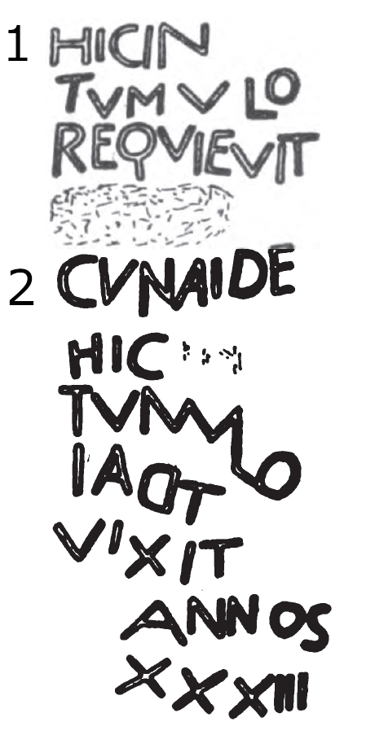
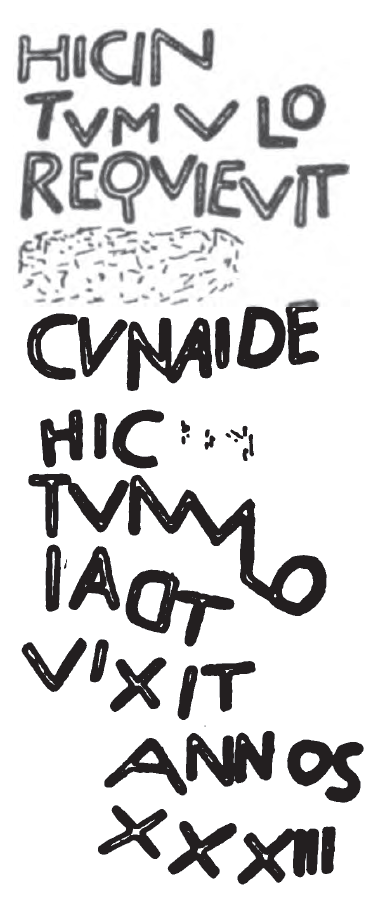
Hayle Stone 479 (Kennedy Grave Stone) - Parish of Saint Erth, Cornwall
Background
(January 11, 2026) This is an important example of a Latin grave stone from near the end of the British Celtic runic stone era (900 CE). It also seems to have one of the first examples of the Kennedy surname. Where their letters overlap both runic and Latin inscriptions used the same letter styles.
Macalister reports that this stone was found in 1843, somewhere close to the place where it is at present. Near it was a stone-lined grave, "6 or 8 feet long" filled “with a mixture of sand, charcoal, and ashes, and entirely covered with a loose heap of stones, the top of which was considerably beneath the surface of the ground. For its preservation it was set upright in a wall close by.
Its original dimensions were 6′0″ × 1' 0" × 0' 8", with a blank space below the inscription apparently about 2′ 6″ long. The stone has now been cut down to 4' 1" x 0' 11 "- thickness undeterminable , as it is fixed in the revetment wall of a bank beside a pathway in a small public park.
References
Cassell's Latin Dictionary by D.P. Simpson (1968) Harper Collins
Translation in Latin (Northern Text 172)
Letter style is Latin
Dictionary used: Cassell's Latin Dictionary by D.P. Simpson (1968) Harper Collins
HIC IN TUMULO REQVI EVIT
CVNAIDE HIC IN TUMULO IACIT VIX(SC)IT ANNOS XXXIII
In English
Here in mound rests, devoid of life, ________
Kunaide here in mound lays his/her flesh, Years 33 (X sounds like SC)
Comment: Kenadie/Kynedi/Kenadee, a modern variant of the Irish surname Kennedy. Kunaide seems to be that name's ancient form. This seems to be a reburial using the same mound as someone from older times. The "X" letter in the text is the Welsh letter for the Druid Akkadian Š. Latin does not have a letter for this sound which sounds like SC.
Previously Attempted Translation
HIC IN TVMVLO REQVIEVIT*
CVNAIDE HIC IN TVMVLO IACIT VIXIT ANNOS XXXIII
No English translation provided
Example of a Latin/Viking Gravestone (800 CE)
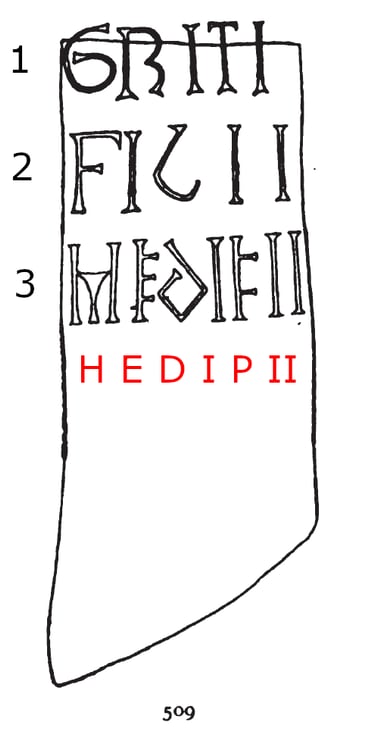
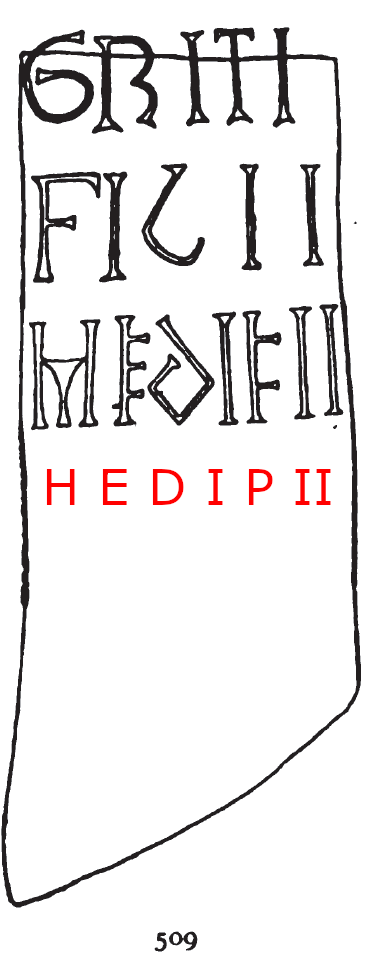
Lethnott 509 - County of Forfar, Scotland
Background
(March 25, 2026) Macalister reports that this stone was found found while repairing the floor of the church. It is now in the National Museum, Edinburgh.
The stone is made from red sandstone having dimensions of 0′ 9 1/2″ × 0′ 4″ × 0' 1 3/4 " ,
References
Cassell's Latin Dictionary by D.P. Simpson (1968) Harper Collins
Macalister, R A Stewart. 1945. Corpus Inscriptionum Insularum Celticarum Volume 1, page 486. Online at: https://www.google.com/books/edition/Corpus_Inscriptionum_Insularum_Celticaru/4jgaAAAAYAAJ?hl=en
Translation in Latin
Letter style is mostly Latin with some Nordic letters (E, P, D) which mostly are used in the father's name.
Dictionary used: Cassell's Latin Dictionary by D.P. Simpson (1968) Harper Collins
GRITI
FILII
HEDIPII
In English
Griti
daughter of
Hedipi
Comment: This shows the transition to Latin writing (daughter's name) from Norse runic writing (father's name).
Previously Attempted Translation
GRITI
FILII
MEDICII
No English translation provided
Celtic Stones Not Listed in Macalister Or Without Text
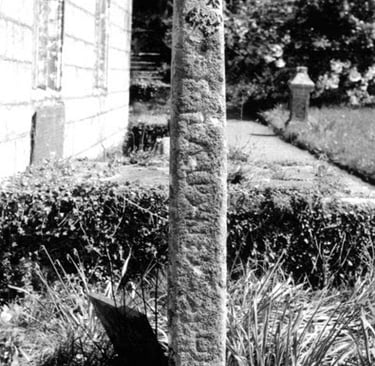
Lanteglos Runestone
(February 22, 2026) This stone is now located in the churchyard of St Juliot's church east of south porch in Lanteglos by Camelford, Cornwall.
It was first recorded 1858 as propping up a barn wall at Lanteglos (Blight 1858, 126). In 1870 it was recorded as being in farm yard on Castle Gough estate (Polsue 1870, 57), this being 200 meters north-west of the church site. It was recorded in 1875 as being in the local rectory garden of Lanteglos (Rhys 1875, 363); It was moved to its present location in 1900 (Langdon, Arthur 1906, 416)
https://chacklepie.com/ascorpus/catvol11.php?pageNum_urls=25&totalRows_urls=94

Thor's Cross
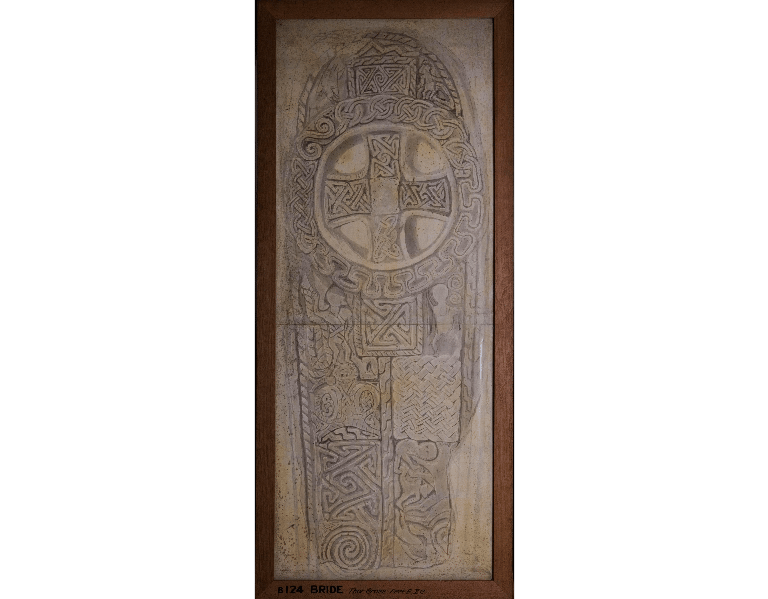
Not all stones on the Isle of Man had text. This stone (called Thor's cross) is shows the Celtic/Druid equilateral cross representing astrology magic. Notice the Druid spiral in the lower left corner. This stone also has several images showing humans. It probably is a mix of Celtic and Viking influences which dates it to about 800 CE.
From iMuseum Date made: ?1906, Artist: Kermode, Philip Moore Callow, Measurements: overall: 153 cm x 63 cm;artwork: 144 cm x 54 cm. ID number: 2006-0295/124Bi
Online at: https://www.imuseum.im/ This is the online service of Manx National Heritage at: https://manxnationalheritage.im/collections/library-and-archives/
© 2022-2026. By David D. Olmsted. All pages licensed under a Creative Commons Attribution-NonCommercial-ShareAlike 4.0 International Copyright. https://creativecommons.org/licenses/by-nc-sa/4.0/